
Before you commission an online shop, work through how customers will find a product, decide whether it is right for them and complete their order. Those decisions shape the product information, navigation and checkout your website needs.
For a Wexford retailer, that planning may also involve an existing shop, stock sold over the counter or products that need different delivery arrangements. A clear brief gives your web designer something practical to build around and helps you understand what the quotation covers.
Start with the products you can describe accurately, photograph and fulfil reliably. Your opening range can be smaller than the range available in your premises. Allow time to prepare the information for each item and decide how it will be kept up to date.
Record which products have options such as size or colour, which are made to order and which have limited availability. If the same stock is sold in your shop and online, agree how stock levels will be reconciled. An automatic connection to a till or stock system needs to be checked and included in the project scope.
Sketch a simple category structure before uploading products. Use names that customers recognise and make it clear where each type of product belongs. For example, a specialist retailer might group products by their main use, with more detailed categories beneath.
Categories, filters and search serve different purposes. Categories let people browse a range; filters narrow that range by relevant attributes; search helps someone who already has a product or model in mind. Agree which of these your catalogue needs. Too many empty categories or filters with inconsistent values can make browsing harder.
Each product page should answer the questions a customer would ask in your shop. Include a clear name, photographs, price, availability and the details needed to choose the correct item. Depending on the product, those details could include dimensions, materials, model numbers or compatibility.
Keep the format consistent across the range. A spreadsheet with one row per product is a useful starting point, especially if the catalogue will be imported. Include a unique product code and keep image filenames organised so that photographs can be matched to the correct item.
Decide where you will deliver, how charges will be calculated and whether collection will be available. Identify items that need different handling, such as bulky or fragile products. These decisions affect the settings and testing needed at checkout.
Agree the payment provider with your designer and check its account requirements and fees. Customers should be able to review their basket, change quantities and understand the order total before paying. The checkout also needs clear instructions when information is missing or a payment cannot be completed.
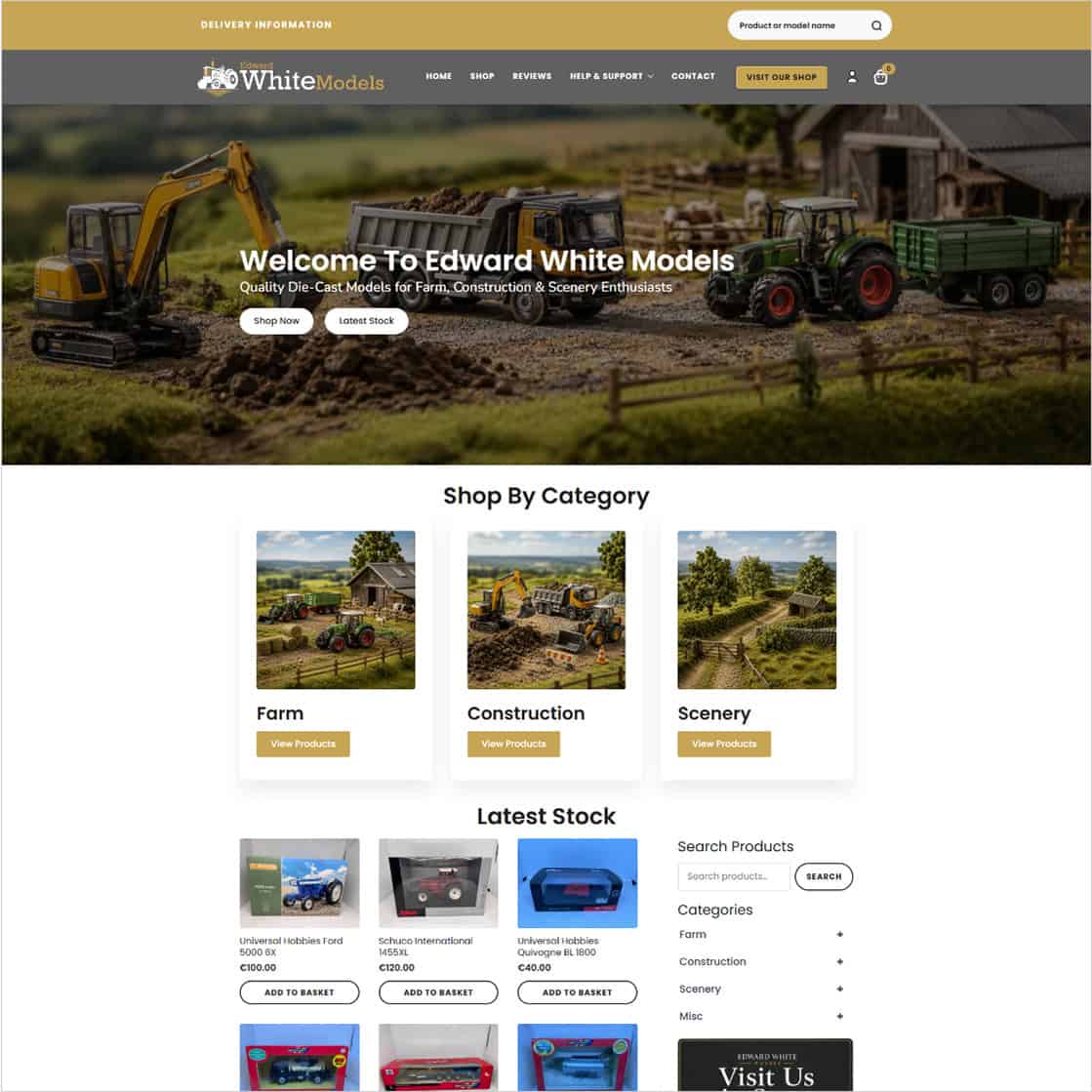
Edward White Models is a specialist model shop in Duncormick, County Wexford, trading online as Toymodels.ie. The ecommerce website we built provides a useful example of how a specialist range can be presented online.
The live shop groups products under Farm, Construction and Scenery, with more detailed categories beneath. Product search gives visitors another way to find an item. A shopping basket and online checkout provide the route from choosing a model to placing an order.
For someone planning a shop, the useful lesson is to work through that whole journey. Check that the category names make sense, that product information helps someone choose and that the basket and checkout are straightforward to use on a phone.
Explore Toymodels.ie or read our Edward White Models website case study for the project background.
Before launch, assign responsibility for changing prices, adding products, checking stock and processing orders. Agree what training and documentation the website project includes, and make sure the people doing the work can practise those tasks.
Also clarify the ongoing costs and support arrangements. Hosting, payment processing, software licences, technical maintenance and future development can involve separate charges. Ask for the scope in writing, including how additional product uploads or content changes will be quoted.
Use a few representative products to check the proposed shop, including an item with options and one with different delivery requirements if your range includes them. Work through the journey on both a desktop and a phone.
Keep a short list of anything that needs attention and resolve it before launch. A successful test order checks the purchasing process; it does not tell you how many visitors will buy once the shop is live.
Bring these details together before requesting a quote. Mark anything you have not decided so it can be discussed as part of the scope.
Use our website cost guide for indicative budgets and our project scope comparison guide to check what a quote covers. For ongoing technical support, see our Website Maintenance & Care Plans. Product uploads and other content changes should be identified and quoted separately.
If you are planning an online shop in County Wexford, send us an outline of your range, an approximate product count and your delivery requirements. Let us know whether you already have a website, shop or stock system so we can discuss the work involved.
Explore our ecommerce website service for Wexford businesses or contact Istech to discuss your online shop.